If you’ve looked at your little living room before and thought about how to turn that space into a larger, more comfortable, functional area….you definitely aren’t by yourself. Finding out how to arrange furniture within an “L-shaped” small living room is one of the most popular searched interior design topics and rightly so. The truth of the matter is that the entire design aspect of your living room must include how you will arrange your furniture, especially when you’re trying to create a functional space out of a compact area (miniature). Need some examples? Consider where the sofa should be placed, will this coffee table make the room packing way too congested, how to create flow between the two sitting areas without compromising seating?
The great news is even if you have an extremely smaller amount (but just as important) in your living-room you can achieve the look of being more open, airy and welcoming. By utilising a basic furniture arrangement technique, and implementing a few key layout principles, along with using a few simple steps will ensure that you are able to achieve all the above-mentioned goals in even the tightest space. The full layout plan will take you through steps ranging from how to measure your room to properly locating each piece of furniture within your determined layout plan; giving you an overall functional space that meets the needs of all users; both growing the possibility of having guests over and encouraging repeat visitors.
Why Furniture Arrangement Matters in Small Living Rooms
Before getting into the “how,” it’s also helpful to know the “why.” Your furniture’s arrangement directly affects the size of your room. If you put everything against a wall, it’s going to look smaller (vice versa). If arranged properly, you’ll create visual space, define zones and move around the space naturally while feeling like it’s an open room.
How you arrange furniture also affects how your room functions. If you put your sofa in the wrong spot, it will block light; if you have an oversized coffee table, you’ll have an obstacle course; and if you don’t properly position your TV, you’ll create awkward viewing angles. Getting it right will save you from having to rearrange and feeling frustrated by your room!
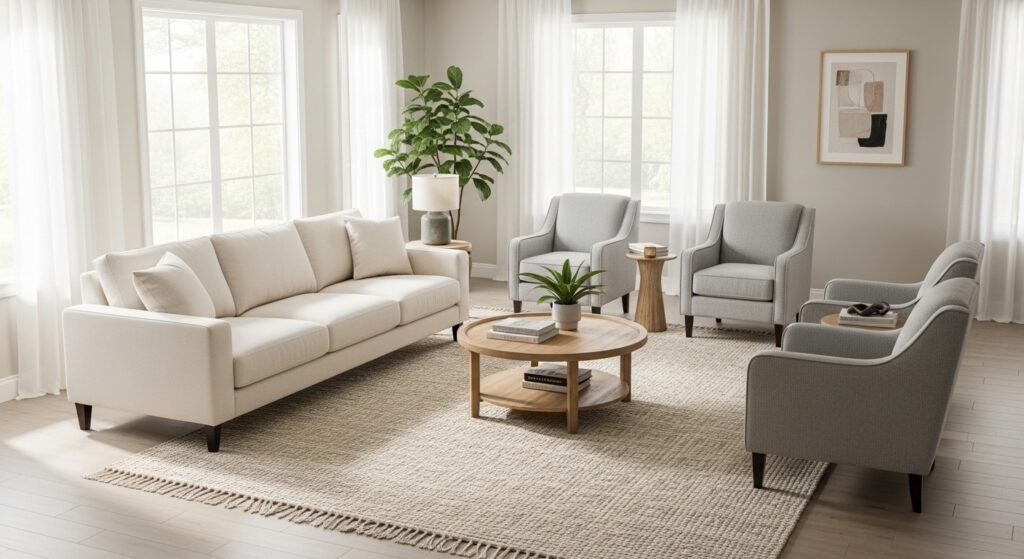
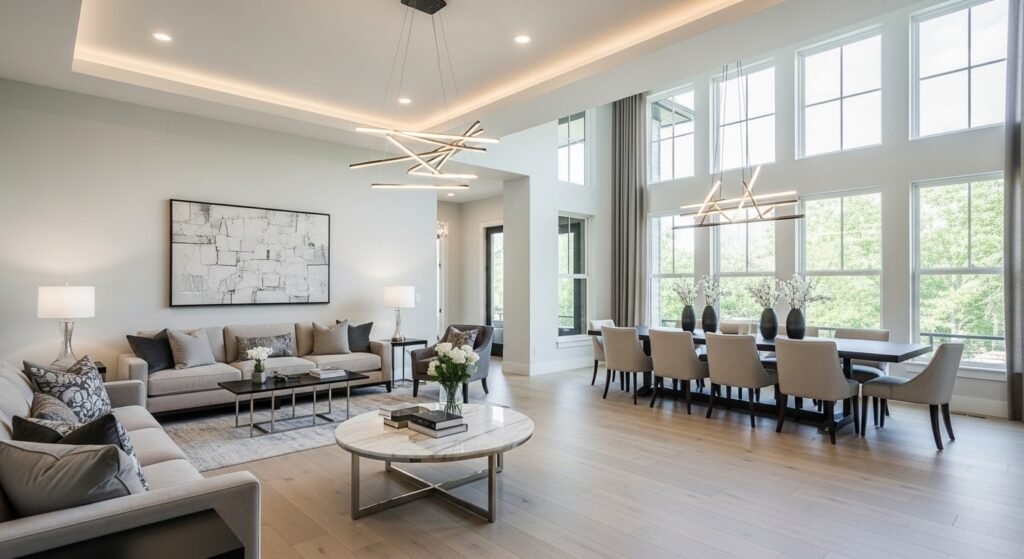
A well-arranged small living room creates the illusion of more space through smart furniture placement.
Step 1 — Measure Your Room Before You Move Anything
The single biggest mistake homeowners make when arranging furniture in a small living room is skipping the measuring step. You need to know your room’s exact dimensions — length, width, ceiling height, and the position of windows, doors, outlets, and vents — before you move a single piece of furniture.
What to Measure
- Room dimensions: Measure the full length and width of the room in feet and inches.
- Doorways and windows: Note where they are and how much wall space they take up.
- Your furniture: Measure each piece — width, depth, and height. Don’t rely on memory.
- Traffic pathways: You need at least 30–36 inches of clearance for comfortable walking paths.
💡 Pro Tip
Use graph paper or a free app like RoomSketcher or Planner 5D to create a scaled floor plan before you physically move anything. This saves your back and your sanity.
Step 2 — Identify the Focal Point of Your Living Room
Every well-designed living room has a focal point — the first thing your eye is drawn to when you walk in the room. In a small living room, choosing and honoring the focal point is critical because it anchors your entire furniture arrangement.
Common focal points include a fireplace, a large window with a view, a TV wall, or a piece of statement art. Once you identify yours, arrange your seating so that it faces or relates to that focal point. This creates an intentional, cohesive look rather than a random scattering of furniture.
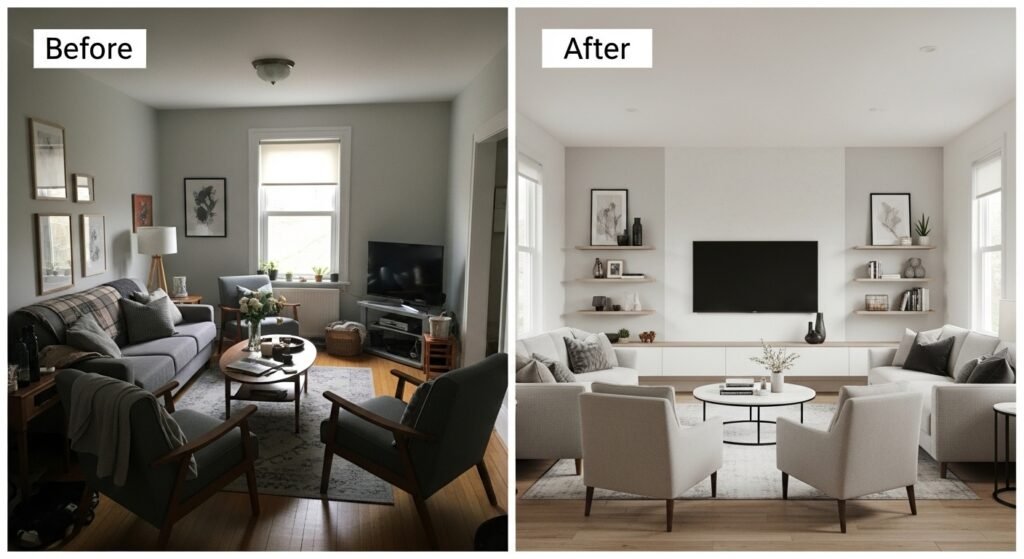
Identifying your focal point is the starting point for any successful small living room furniture arrangement.
Step 3 — Choose the Right Furniture Layout for Your Room Shape
No two small living rooms have the same shape, so your furniture placement strategy depends upon your room’s shape. Here’s how to arrange your home furnishings for the most popular types of common home layouts.
A. Square Shaped Interior The Room
Because there is no single long wall on which to place furniture in a square room, they can be particularly difficult to arrange properly. Therefore, the best way to arrange your furniture is to have your sofa floating away from the walls, facing the most prominent feature of the room, and two additional chairs facing the sofa. To make the square room feel less geometric and promote ease of traffic throughout multiple furniture pieces in the room, use round or oval coffee tables (and not rectangular tables).
B. Rectangular Shaped Interior
The rectangular home layout is the most popular, and the easiest of all types of layouts for a small living room. The best way to create an elongated space in your home is by placing your largest piece of furniture (the sofa) on either the long wall of the room, which not only preserves the illusion of an elongated space but also leaves the short wall free of furniture. If there is a very long and narrow room, you can define the living area and make the room feel less like a bowling alley using a large rug in your living area with all the furniture on it.
C. The L-Shaped Room
In an L-shaped space, the inner corner of the L is your natural zone for a furniture grouping. Place the sofa at the corner of the L and use the two “arms” of the L for chairs or a chaise. This takes advantage of the angular shape rather than fighting it.
Small Living Room Furniture Arrangement Diagram
Visual learners rejoice — here is a simple top-down diagram showing an ideal furniture arrangement for a small rectangular living room (approximately 12 × 14 ft). Use this as a starting reference and adapt it to your specific space.
🗺 Top-Down Layout Diagram — Small Rectangular Living Room (~12×14 ft)
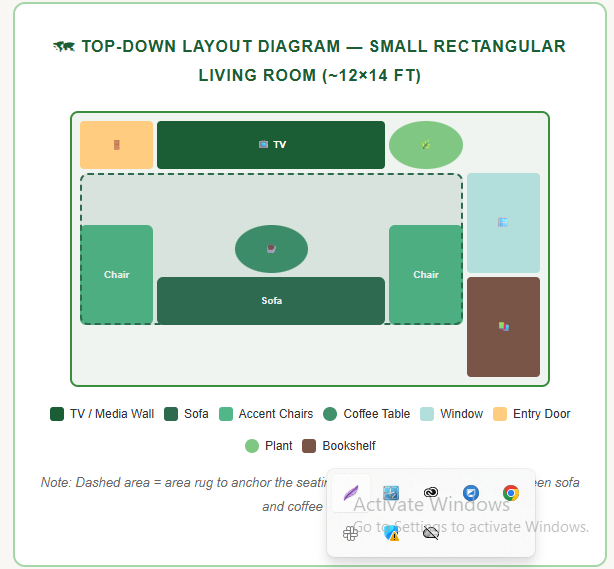
Note: Dashed area = area rug to anchor the seating group. Leave 18–24 inches between sofa and coffee table.
A labeled diagram makes it easy to visualize where each piece of furniture belongs in a small living room.
Step 4 — Follow the Golden Rules of Small Living Room Arrangement
Skilled interior design professionals have established guidelines on how to place furniture in small spaces that have stood the test of time. Knowing these fundamental principles will help you make informed choices with confidence.
Rule 1: Put Your Furniture in the Center
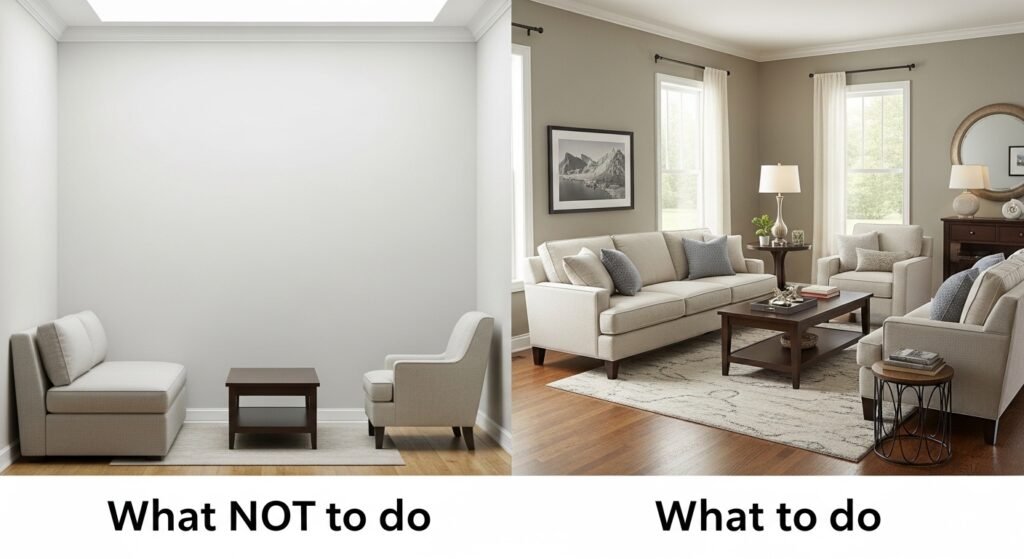
Do not make the mistake of pushing everything up against the walls. Take some of your furniture away from the walls and put it out in front of or right next to each other so that there is some distance between them. By doing this, you are creating space for the people sitting and talking with each other as well as creating a more welcoming atmosphere in the room. This is the most effective design principle for using space in small areas.
Rule 2: Make Sure You Have Enough Room Between Seating Areas
When you are designing a seating area, you want everyone who is charged with communicating to be able to sit comfortably and hear each other without having to strain or lean forward. The greatest distance between seating areas is no greater than 8 feet. Position furniture in such a way that all the chairs and sofas face each other or at a slight angle. This will ensure that everyone in the room can effectively communicate and feel comfortable doing so.
Rule 3: Allow a Minimum of 15 Inches of Seating Space On All Sides of the Coffee Table
A coffee table needs to have 15–18 inches of distance from the sofa on each side. This will allow a person sitting on the sofa to be able to use the coffee table with ease, as well as for a person standing to be able to sit down and walk around comfortably. A coffee table that is placed too close to or too large for a person is going to be an aggravation to that person.
Rule 4: Use a Rug to Define the Zone
An area rug is one of the most powerful tools in small living room design. It anchors the seating group, defines the “living” zone, and adds warmth and texture. The ideal rug size for a small living room is one where all the front legs of the sofa and chairs sit on the rug — this creates visual unity without overwhelming the space.
Rule 5: Prioritize Scale
Oversized furniture is the number one killer of small living rooms. Every piece should be proportional to the room. A massive sectional sofa might be your dream couch, but in a 10×12 room it will eat up all your floor space and leave you feeling claustrophobic. Choose furniture that fits the scale of the room, not the scale of a showroom floor.
Step 5 — Maximize Vertical Space and Light
Going vertical overcomes restrictions on floor space by drawing the eye upward with tall bookshelves, curtains hung from ceiling to floor, and TV sets mounted high on the wall, which all give an illusion of height to the room and thus make it feel less cramped; placing artwork higher on the wall than normal also creates this illusion.
Natural light is an essential element for making a space feel larger; do not put large bulky furniture in front of your windows, as this blocks natural light, creating a dark, small space; likewise, keep your windows free of window coverings and use light (sheer) window coverings, so that you can enjoy maximum natural light exposure through them; if privacy is important, consider bottom up shades or a frosted glass film for your windows instead of heavy window coverings.
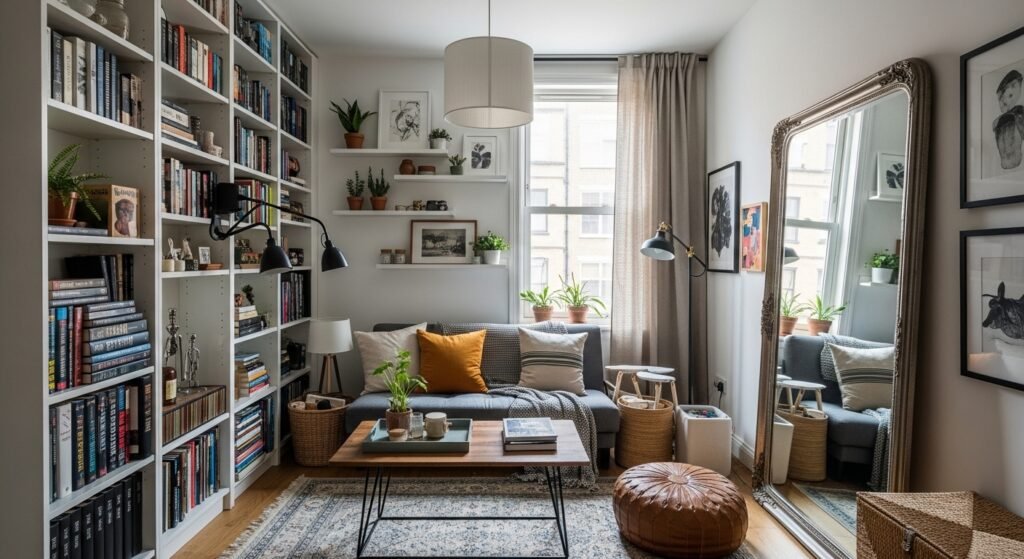
Best Furniture Choices for Small Living Rooms
The furniture you choose is just as important as how you arrange it. Here’s a quick reference table to guide your selections:
Furniture PieceBest Choice for Small RoomsWhat to AvoidSofaMid-size 2–3 seat sofa with exposed legsLarge sectionals, low-profile bulky sofasCoffee TableOval or round glass-top tablesLarge rectangular solid-wood tablesSeatingAccent chairs or poufs with slim profilesOversized armchairs or loveseatsStorageOttomans with storage, wall shelvesBulky media consoles or armoiresTV StandFloating wall-mounted TV unitFloor-standing entertainment centersLightingFloor lamps, wall sconces, pendant lightsOversized table lamps on small surfaces
Common Mistakes to Avoid When Arranging Furniture in a Small Living Room
You want to make the best use possible of your space. One common mistake is that you have too many furniture pieces. When it comes to styling your living room, less is always best! For example, if an item doesn’t have a purpose then you do not need to have it in the room.
Another common mistake is ignoring traffic patterns and flow in your living room. Every room has at least one clear walk-through path that should have a minimum of 30-36″ clearance so people do not feel trapped between the walls and your furniture pieces.
Another common mistake is to create a very “matchy-matchy” type of space by having all of your furniture pieces be matching. This gives your room a heavy, furniture store look. You want to mix up your furniture pieces at different scales and with different styles to help create visual interest without overcrowding your room with furniture.
Neglecting corners is another common design pitfall. Corners are wasted space, so you might as well use that space to help add some personality to your small room and/or free up some additional floor area.
If you have a rug in your living room that is too small, it can look like an afterthought and diminish the overall appearance and design of the room. Therefore, make sure that you choose the largest rug possible for your small room.
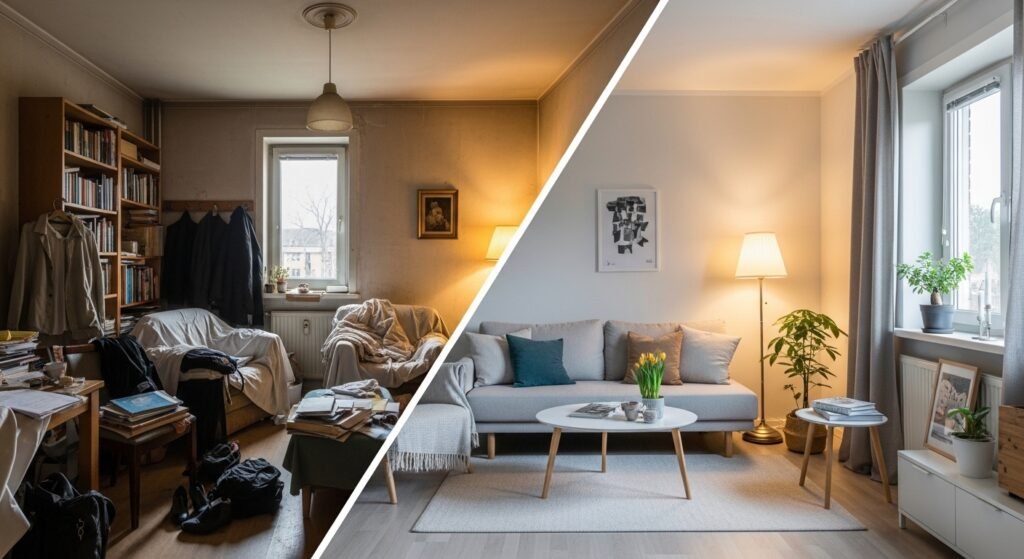
Avoid these common furniture placement mistakes to keep your small living room feeling open and functional.
Quick Layout Ideas by Room Size
Different small living room sizes call for different strategies. Here’s a quick guide based on square footage:
Under 100 sq ft — Micro Living Room
In the smallest of spaces, choose a loveseat over a full sofa, use a nesting set of tables instead of a fixed coffee table, and mount your TV on the wall. Multi-functional furniture — like a storage ottoman that doubles as a coffee table — is your best friend here.
100–150 sq ft — Compact Living Room
You have room for a three-seat sofa and one accent chair. Place them in an L-shape with a small round coffee table between them. Add a slim console table behind the sofa for extra surface space without blocking the room’s center.
150–200 sq ft — Small-But-Manageable Living Room
This is the sweet spot for most small living room designs. You can achieve a full U-shape or L-shape seating arrangement with a sofa, two accent chairs, and a coffee table. There’s also room for a side table, a floor lamp, and one or two decorative accents.
Final Thoughts
It is all about working with your space rather than fighting against it. There is potential in every small room; it just needs a little thought. Start by measuring your space, find your focal point, use an arrangement that matches your room’s shape, adhere to the golden rules of furniture placement, and use pieces that are proportional and functional.
The diagram and tips included in this guide provide you with a great starting point, but the best arrangement will always be the one that meets your individual needs. Be open to experimenting and tweaking things; don’t hesitate to explore non-traditional arrangements. Sometimes by floating your sofa away from the wall or swapping your traditional coffee table for a round one, you can totally change the way you feel about your small, cramped living room.
Want us to help with your specific room layout? If so, please leave us a message in the comments section below; we would love to help you achieve the furniture arrangement of your dreams in your small living room.
Read More:
How to Decorate a Small Living Room on a Budget (Full Guide)
Best Bedroom Color Combinations for Better Sleep (Backed by Psychology)