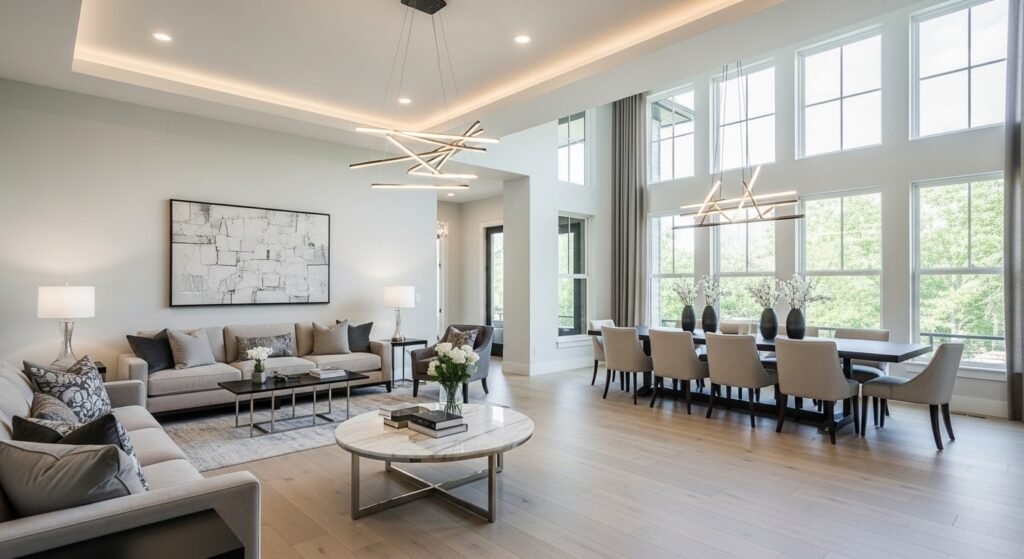
Few interior design moments feel as good as this. You walk into a small living room. It feels spacious, bright, and well laid out.
Regrettably, many homeowners are unable to find the right approach to achieving this feeling. If you’ve been looking for guidelines on how to expand your small living room, look no further!
The good news is you can make a small space feel open and airy. You can do this without tearing down walls, moving, or spending much on remodeling. Professional interior designers use simple design and space tricks.
These tricks can turn cramped, messy rooms into spaces that feel open and pleasant to live in.
In this article, we outline all fifteen tricks. We explain them simply, with helpful tips. You can start using each one at home today.
These strategies can be applied to a living room whether it is 80 square feet or 180 square feet in size to get the most out of that living area. Now let’s get started!
Why Small Living Rooms Feel Cramped (And How to Fix It)
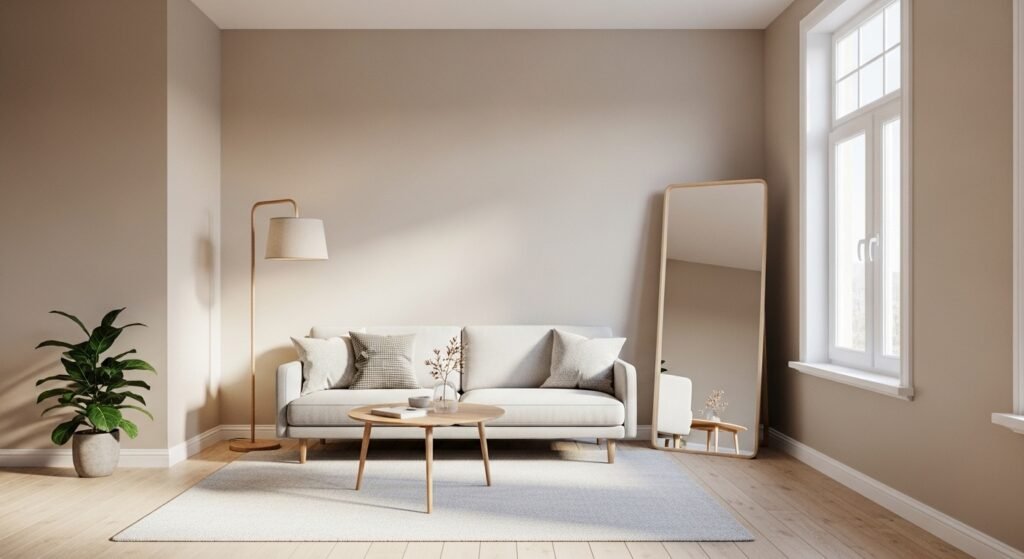
To understand how to make a small living room look larger, know why it feels small. Large furniture can crowd the space. Dark paint absorbs light. Too many visual distractions can feel overwhelming.
For the brain to perceive space it uses visual cues such as line, contrast, light, and proportion. If the room gives positive visual cues, the brain sees it as spacious, even if it is small.
Conversely, if the room gives negative visual cues, then even a large room can feel claustrophobic. Each trick in this document uses positive visual cues. These cues tell your brain, and anyone who enters, that your living room is spacious.
Designer Insight
You don’t always need more space — you need better visual communication. A small living room that is well-lit, lightly colored, and thoughtfully furnished will consistently feel larger than a bigger room that is dark, cluttered, and mismatched.
15 Designer Tricks to Make a Small Living Room Look Bigger
TRICK 01: Choose Light, Neutral Colors for Your Walls
The most important color in a tiny living room is color. Light colors, like soft white, warm cream, pale gray, and light greige, reflect more light.
They reflect light from natural and artificial sources, like lamps and bulbs.
They reflect more light than dark colors.
This helps a room feel bigger, deeper, and more airy.
It can also make walls seem like part of the open space. This change in colour is the first and most significant for making a small living room feel larger.
Some of the best-known designers rate the small living room as: Benjamin Moore’s Chantilly Lace; Sherwin Williams’ Alabaster; and Farrow and Ball’s Elephant’s Breath. Do not paint all your walls dark or in rich, deep colors.
This can make the room feel closed off, even if it looks good on Pinterest.
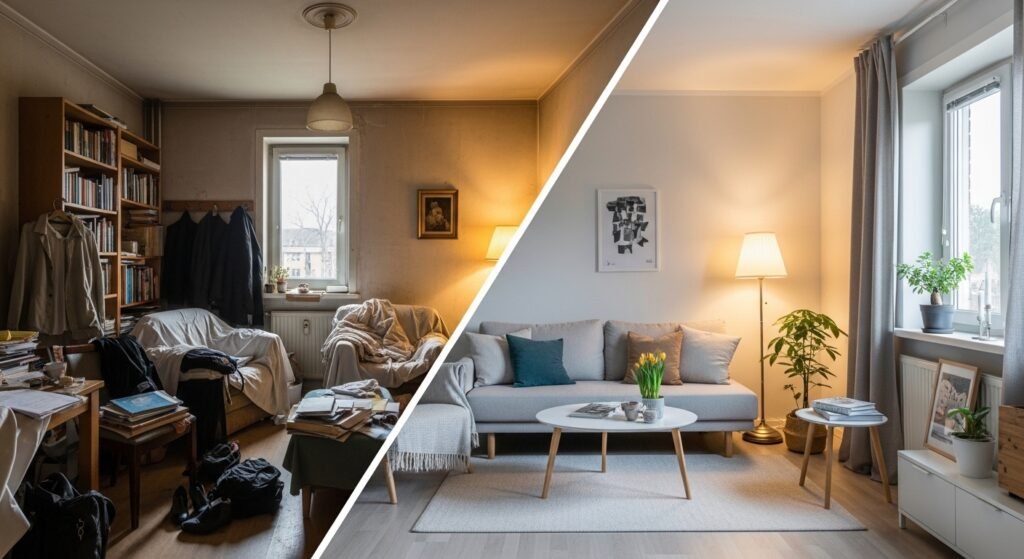
Insert a side-by-side photo showing the same small living room painted in a dark color (navy or charcoal) vs. a light color (soft white or pale gray). The contrast will visually reinforce the point about color and perceived space.
Alt text: “Small living room painted in light vs dark colors showing how color affects perceived space”
TRICK 02: The Strategic Use of a Large Mirror
Mirrors can be a designer’s best tool in small spaces. Having a large mirror across from a window not only appears to double the distance of the room but also reflects natural lighting throughout the room. You will notice a dramatic effect when a room appears twice as spacious because of the use of mirrors.
Using a full wall mirror, or a large statement mirror on the wall opposite your main window, will provide the largest impact. Avoid placing mirrors where they will reflect clutter and unattractive views because mirrors will enhance every item in front of them, both positively and negatively.
TRICK 03: Maximizing Natural Light
Natural light is the best free source of “space” that there is. Therefore, your every design decision for a small living area should protect and enhance natural light.
Removing bulky furniture from in front of windows can boost natural light in your small living area. Replace heavy fabrics with sheer linen curtains. Use light-colored window treatments that diffuse sunlight instead of blocking it.
If privacy matters, try options that keep light and add privacy. Use frosted window film, bottom-up cellular blinds, or sheer Roman shades. Avoid dark or blackout curtains in a small living area. Use them only if harsh sunlight shines through the window glass.
TRICK 04: Install Your Curtains High and Wide
Hanging your curtains high, near the top of the windows, is a common designer tip.
You can also extend the curtain rod beyond the window frame on each side.
This is one of the easiest and least expensive ways to make windows look taller.
It also makes your ceilings seem higher by creating a simple visual illusion.
The eye is drawn upward, making the whole room feel taller and more open.
Use full-length curtains resting about one-fourth inch from the floor. Using full-length curtains creates the most dominant visual effect of all the design tools available to interior designers by having this long vertical line.
TRICK 05: Choose Furniture with Legs Exposed
For example, placing a sofa directly on the floor can create a visual divide.
A square upholstered armchair without exposed legs can do the same.
It can look like a “wall” at floor level between the front and back areas.
On the other hand, if you choose a sofa with exposed legs, it can make the room feel bigger.
For example, an armchair with exposed legs lets you see under the furniture.
Your view can pass beneath and beyond the piece, with fewer visual blocks.
This creates a more open look, so the whole living area appears larger.
Look for sofas, chairs, and coffee tables with slim metal or wooden legs. Even a few inches of visible floor under each piece adds up to a significantly more spacious-feeling room.
TRICK 06: To make your small living room feel more spacious, use a coffee table made of glass or Lucite.
Because both materials are transparent and let light pass through, they create little visual weight. The eye cannot easily see clear boundaries in them. Thus, a glass coffee table will not change the room’s visual size, no matter how large it is.
For a very modern style, pair a glass coffee table with a simple metal or very narrow wooden frame.
TRICK 07: Use A One-Color Scheme
Using several shades or tints of one color in your home creates harmony.
It gives a smooth visual flow between furnishings, like a sofa and a matching rug.
This can make a small space feel much larger.
Your home doesn’t have to have a decorative scheme that includes all of the same type of item (such as furniture or wall treatments) for it to appear cohesive. To achieve an elegant designer appearance, use various textures (such as linen, velvet, wood, and wool) that come from the same color family.
TRICK 08: Floating furniture
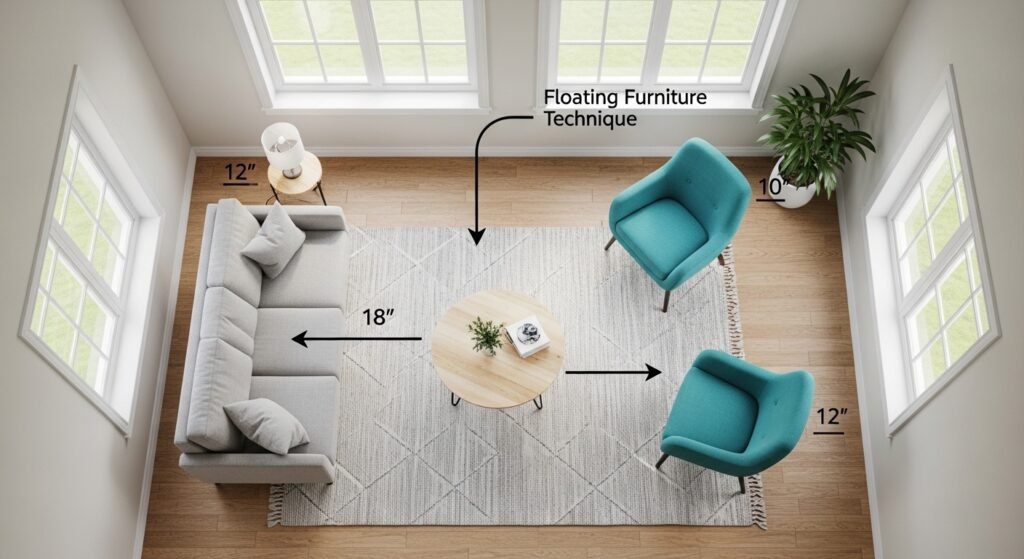
In a small room, you may push furniture against the walls. This can leave the center open, hoping the space feels larger.
By floating furniture, you can pull pieces a few inches or one foot from the walls.
This creates a cohesive group for conversation.
It anchors the space and adds visual unity.
It can make the room feel larger than it is.
It also makes the design feel more intentional.
There will also be more memory associated with the thought that when you look at all of your furniture from the wall to your sofa, you have more depth to your room.
TRICK 09: Make use of Vertical Lines to Increase the Height of a Room
Vertical lines can help raise the viewer’s eye to the ceiling and also make rooms appear taller than they actually are. Also, an arrangement of pictures, such as on a gallery wall, in a tall narrow column versus a wide horizontal layout will add height as well.
The key is to change the flow of the viewer’s eye from the limited amount of floor space to the vertical dimension of the room, which is the main reason that many smaller rooms don’t take advantage of their full potential.
TRICK 10: Choosing a Properly Sized Area Rug
A rug that is too small in a small living room can create an even smaller, more disjointed feel to the room with the area rug (the “floating” look) being in the center of the room like a stamp. Choosing the right size area rug will help to anchor your seating area and establish an integrated space that visually appears to be one large area.
The general guide is: Pick an area rug that is large enough that all of the front legs of your chairs and sofas sit on it. If your budget permits, choose a larger area rug. Choosing a rug that has been extended with the edge coming within 12-18″ of each wall will also give you a more expanded, wall-to-wall feel to your living room, which will increase the size of your living room.
TRICK 11: Declutter Ruthlessly
Completely eliminate all clutter, visual clutter, and distracting decor in order to create a space that looks larger.
- Organizational Design Tips For Small Spaces.
- Remove all visual clutter that would create eyes tons of frustration and, ultimately, challenge the mind’s perception of space.
- Use three decor items to an area (Perpendicular to the item’s layout) in an exclusive triangular design.
- When designing furniture use functional furniture only.
- Get rid of things that don’t provide value to you.
- Keep a minimalistic style and it will help make your home feel larger
Visual Clutter: Too many throw pillows, stacks of magazines, decorative objects placed all over the place, cords/cords tangled together are examples of the types of things that create visual clutter and auditory distraction (Noises) for the mind as it tries to determine how many square feet or meters are present in a room.
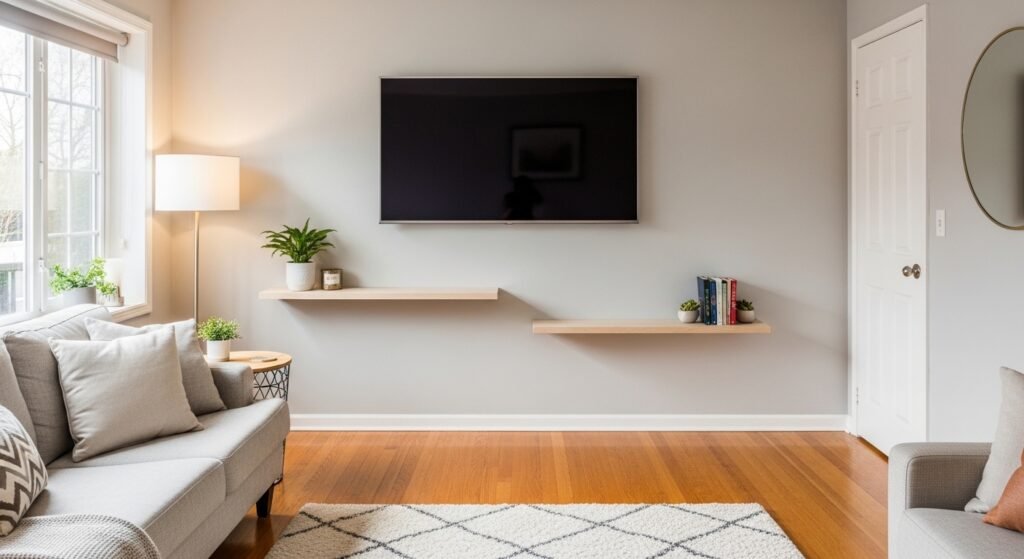
TRICK 12: When you place your television on a wall with no visible stand or console it provides you with a lot of floor space that was previously taken up and makes your small room feel larger. A wall mounted television will also create an impression of height in the room since people will see the television, above head height, which gives them a feeling of an open area.
For the best possible design, consider using an in-wall cable management kit so that you can conceal the cables for your television behind the wall. In addition, consider using floating shelves below the television for your various media devices, such as streaming devices and remote controls, eliminating any visible bulk from a traditional console unit.
TRICK 13: Have Furniture That Serves More Than One Purpose
Every piece of furniture in a tiny living area should perform multiple functions. For example, a storage ottoman can act as a coffee table, provide additional seating and offer concealed storage, all at once. The console table behind the couch serves double duty as an office desk. Nesting tables provide spare surface area that can be tucked out of sight when not in use.
Using multi-functional furniture decreases the number of furniture items needed in the room, and, when you have fewer items, you have a more open and spacious feeling in the room. Think of it this way: only keep the furniture in your house that has a specific purpose — only the pieces that earn their keep are worth keeping.
TRICK 14: Layer Lighting for Depth and Warmth
Relying on a single overhead light source flattens a room and makes it feel smaller and more cave-like. Layered lighting — combining ambient (overhead), task (reading lamps), and accent (wall sconces, shelf lighting) — creates depth, dimension, and warmth that makes a small living room feel rich and expansive.
A well-lit room always feels larger than a dimly or harshly lit one. Use warm-toned bulbs (2700K–3000K) throughout for a cozy, inviting glow. Uplighting — floor lamps that direct light toward the ceiling — is especially effective at making ceilings feel taller.
TRICK 15: Use Consistent Flooring Throughout
If your living room connects to a hallway, kitchen, or dining area, using the same flooring material throughout all connected spaces creates a seamless visual flow that makes every area feel larger. Breaking up the flooring with different materials or colors creates visual barriers that chop the space into smaller-seeming sections.
If you’re not in a position to change your flooring, an area rug that complements (rather than contrasts sharply with) the existing floor achieves a similar sense of continuity.
Your Small Living Room Makeover Checklist
Before you finish, run through this checklist to make sure you haven’t missed any of the 15 tricks. Print it out or save it to your phone for reference while shopping or rearranging.
Small Living Room Look Bigger — Designer Checklist
- Walls painted in a light, neutral color
- Large mirror placed across from a window
- Windows kept clear of bulky furniture
- Curtains hung near the ceiling, rod extended wide
- Sofa and chairs have exposed legs
- Glass or Lucite coffee table in use
- Color scheme is monochromatic or tonal
- Furniture is floated slightly away from walls
- Vertical elements used to draw the eye upward
- Area rug is sized correctly for the seating group
- All surfaces decluttered (max 3 objects per surface)
- TV is wall-mounted, no floor-standing console
- At least one piece of multi-functional furniture
- Three lighting layers in use (ambient, task, accent)
- Flooring is consistent across connected spaces
3 Bonus Tips Designers Never Skip
Beyond the 15 main tricks, here are three additional designer insights that consistently make a big difference in small living rooms:
1. Utilize Fewer and Larger Decorative Items
The majority of homeowners tend to fill small living spaces with numerous decorative items (think; small photo frames, small flower vases, and small decorative sculptures). Many times this creates visual clutter or visual noise. Designers typically do just the opposite. They only use large or oversized decorative items for accent Lighting or as a focal point in a room. For example, utilizing only one, oversized statement vase is a better design choice than having several, small statement vases placed together on a shelf (even though large vases typically take up more space than small vases).
2. Select a Simple Design for Your Sofa
Sofas or couches tend to be the most significant piece of furniture in any living or family room as well as the largest visual presence for any given room. A good design choice for your sofa would feature a simple, clean design and low back to reduce the visual weight of the sofa and provide a feeling of spaciousness in the living room design by showing more wall above the sofa. It is also advisable to select a sofa without rolled arms, tufted back or heavy skirt so they do not add any unnecessary to the visual weight of your sofa or to create an additional visual bulk for the overall aesthetic of your living room design.
3. Apply Greenery Intelligently
Incorporating greenery into your small living room will provide freshness and help give the illusion of being outdoors, helping to create the illusion of space. For example, placing a large potted tree in a corner of your small living room gives height to the room by filling a previously unused corner and drawing attention upwards. A trailing plant can provide beauty to the room by being placed on a high shelf and will not occupy any of the limited floor space. Just having one green plant in the window will add vitality to the area and make it feel much larger and more inviting.
Conclusion:
Ultimately, knowing how to increase the size of a small living room comes down to understanding light, colour, proportion, and flow. All 15 tricks can be done without knocking down walls or spending money. Most are rather inexpensive, or free—completely implementing all of them can be done this weekend!
The best way to get started is to start with the easiest: declutter your space, paint in a light, neutral colour, hang curtains higher than windows, and pull furniture slightly from walls—each of these four options is free or inexpensive and will significantly change how your room feels even before making any changes to furnishings.
From there, continue through the checklist at your own pace and at your own budget. Each trick adds to the effect of those done before, and eventually you will walk into your living room and think of it as a much larger, completely different space. That’s the beauty of great design no matter what the size of the room is.
Do you have any questions about your specific living room? Please leave them in the comments, and we would be happy to help you determine which of these 15 ideas will have the greatest impact.
Read More:
How to Decorate a Small Living Room on a Budget (Full Guide)
Best Bedroom Color Combinations for Better Sleep (Backed by Psychology)